
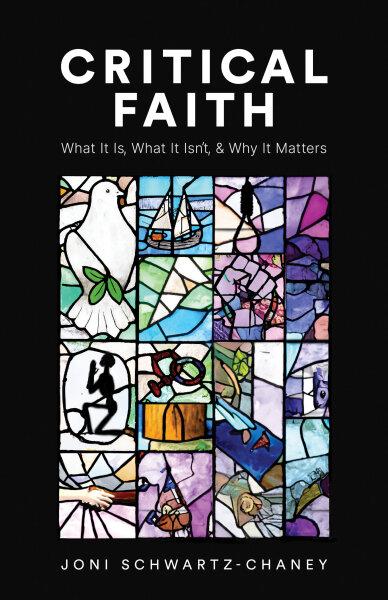
Near hysteria has erupted in the media, state and federal legislatures, community boards, and churches around critical race theory (CRT). Despite the term’s history, development, and clearly defined meaning, it has become a catch-all for white America’s fears, deflections, and equivocations on race, society, and the law. Christians are no exception. Their critiques routinely claim that CRT is rewriting of American history, that it is anti-democratic, and even heretical.
Critical Faith presents a counter argument to these claims and insists that CRT is a tool to grapple with the thorny issue of race in both society and the church. In a reasoned tone, Critical Faith defines the origins of CRT, explains what the theory is, and demonstrates its merits from teaching experiences of the author.
Schwartz-Chaney argues that CRT is the victim of what Patricia Williams calls “definitional theft,” and that by recovering its original meaning, Christians can move past mischaracterizations and caricatures toward a more nuanced view of race, racism, and the tools available to make progress in the church and in society.
- PUBLISHER Fortress Press
Race, Education & Reintegrating Formerly Incarceration Citizens, Rowman & Littlefield Publishers
Learning to Disclose: A Journey of Transracial Adoption, by Joni Schwartz & Rebecca Schwartz, Peter Lang Publishers
Joni and Rebecca Schwartz in their collaborative autoethnography, Learning to Disclose: A Journey of Transracial Adoption, are doing soul work. This adult white mother and black daughter reflect and dialogue around the places and histories that shaped their relationship. Through three voices: the voice of critical history, the daughter and the mother, the co-authors excavate the past to see if and how it lives in their present. In an intriguing mix of critical history of places like Port-au-Prince, Haiti and Gulu, Uganda as well as lesser-known narratives of W.E.B. Dubois, Jean-Bertrand Aristide, and Shirley Chisholm, the co-authors tell their own personal and moving stories of becoming mother and daughter engaging such topics as racial identity, disclosure, racial appropriation, colonialism, and the complex history of transracial adoption.
For anyone interested in racial identity in the complex world of blended families and adult mother and daughter relationships, this is a must read. This book is ideal for all humanities and social science courses across disciplines from sociology, education, qualitative research, and social work to race and communication studies. In this era of strained and confusing racial dialogue, this book is refreshing in its honesty, moving in its personal narratives, and instructive in its engagement in how the historical lives in the social imagination of our present lives and relationships.

Gifts from the Dark: Learning from the Incarceration Experience published by Rowman & Littlefield.
While in no way supporting the systemic injustices and disparities of mass incarceration, Gifts from the Dark: Learning from the Incarceration Experience argues that we have much to learn from those who have been and are in prison. Schwartz and Chaney profile the contributions of literary giants, social activists, entrepreneurs, and other talented individuals who, despite the disorienting dilemma of incarceration, are models of adult transformative learning that positively impact the world. The authors interweave narratives with both qualitative and quantitative research references to analyze the role of solitude, writing, non-verbal communication; race and gender; physical exercise; education; technology; family and parenting; and the need to “give back” that precipitate transformative learning. The prison cell becomes a counterspace of metamorphosis. In focusing upon how men and women have chosen the worst moments of their lives as a baseline not to define, but to refine themselves, Gifts from the Dark promises to forever alter the limited mindset of incarceration as a solely one-dimensional, deficit event.
 Joni Schwartz-Chaney